
Tuesday, August 10, 2010


Times that try men's souls: on to Valley Forge!

Opportunities like these, directly seeking a person who does exactly what you had been doing for a decade, tend to be the most exciting - and frustrating - job listings one runs into. Logic and pride dictate that, naturally, you are the only person who could possibly fill this position. Experience and reality, on the other hand, tend to prove that not only aren't you the only one, but there is still a very good chance you won't be given so much as the courtesy of a nice "Get Lost" letter.
There is a certain amount of irony in the fact that, with time ticking away to personal disaster, my current last, best hope of redemption may lie in at the scene of Washington's greatest hardship.
Reviewing his options while wintering at Valley Forge, Washington wrote, "If all else fails, I will retreat up the valley of Virginia, plant my flag on the Blue Ridge, rally around the Scotch-Irish of that region and make my last stand for liberty amongst a people who will never submit to British tyranny whilst there is a man left to draw a trigger."
At least George had a back up plan. I don't think the Blue Ridge Scotch-Irish are my demographic...
Monday, August 9, 2010
In search of a suitable hat
Life without a roof means a life in the sun, and with it, the melanoma that flesh is heir to. This, I suppose, is why most hobos, tramps and bums are ordinarily pictured in haberdashery. Although not ordinarily a clothes horse, I would hate to break a long standing tradition. So, I am in search of a suitable chapeau.
 Chaplin - and most of the Keystone tramp comics - favored the bowler as the symbol of crumbled prosperity, while the Depression era hobos tended towards the ubiquitous fedora. In modern times, the hoodie and baseball cap combination has been the downtrodden's choice.
I've never been one to follow the crowd, and as I have already laid claim to the bum moniker "The Professor" for this Depression (imitators, take note - ®), I think I need to choose more in keeping with my position in the hobo community as the smartest bum on the block.
 I've become partial to the Henschel Breezer, in earth tones to hide the dirt. Old-school collegiate hatband, with a wide 2.5-inch brim to keep the radiation at bay, the hat holds its style well while still looking capable and suitably "outdoorsy."
Admittedly, my first choice would have been a classic fedora, but I'm afraid that with my khakis and messenger bag, people would mistake me for a bloated Indiana Jones.

I've never been one to follow the crowd, and as I have already laid claim to the bum moniker "The Professor" for this Depression (imitators, take note - ®), I think I need to choose more in keeping with my position in the hobo community as the smartest bum on the block.

Admittedly, my first choice would have been a classic fedora, but I'm afraid that with my khakis and messenger bag, people would mistake me for a bloated Indiana Jones.
A group of hungry people, talking about steak
Human Services buildings score high on the misery scale, right behind trauma centers and police stations; if you're there, and not paid to remain there, you've got some pretty dire problems cooking. Everyone is familiar with Emma Lazarus' lines from The New Colossus etched on the Statue of Liberty: "Give me your tired, your poor/Your huddled masses yearning to breathe free." These buildings are where society cashes that invitation's checks.
Today, as part of the huddled masses, I invaded the basement of one of these buildings to re-acquaint myself with an old nemesis; The Professional Services Group. It is an odd duck program; unlike most of the activities in buildings like this one, it is aimed at the white collar workers.
The people that, in theory, were never supposed to end up here.
 My first experience with the concept was not promising - in fact, it bordered on the delusional. Set adrift from the workaday world, it was the business world recreated in microcosm, in a small cloistered room at the end of some anonymous hallway. There, people marched in at nine in the morning sharp in full business attire, and wrote newsletters to each other. The topics were surreal, considering the sources - "How to find and keep your dream job," by Eddie Kloyski... an 8-month unemployed middle manager.
Once enough of these pearls were strung together, they were printed out, collated and stapled, and everybody who contributed got a copy. Then a pile was left on a table somewhere, in case some passing drifter needed free enlightenment.
In between issues, they would interview each other, offering the kind of sage Human Resources advice that can only come from someone who has never actually worked in Human Resources before.
It was make-work; it was a support group, disguised as positive action. It was an illusion of normality in an extremely abnormal situation for people used to having some control and function in their lives. In the end, it was a non-reality I could not subscribe to.
And so, here I am in a different building, the same program, and a laced, tacit promise of a different mindset. Laced with warnings of "clunkers" and "troublemakers" that didn't fit the program. And, among the handouts... a newsletter.
I wonder - does my skepticism rank me as a "Clunker" and "Troublemaker?" It wouldn't be the first time.
Today, as part of the huddled masses, I invaded the basement of one of these buildings to re-acquaint myself with an old nemesis; The Professional Services Group. It is an odd duck program; unlike most of the activities in buildings like this one, it is aimed at the white collar workers.
The people that, in theory, were never supposed to end up here.

Once enough of these pearls were strung together, they were printed out, collated and stapled, and everybody who contributed got a copy. Then a pile was left on a table somewhere, in case some passing drifter needed free enlightenment.
In between issues, they would interview each other, offering the kind of sage Human Resources advice that can only come from someone who has never actually worked in Human Resources before.
It was make-work; it was a support group, disguised as positive action. It was an illusion of normality in an extremely abnormal situation for people used to having some control and function in their lives. In the end, it was a non-reality I could not subscribe to.
And so, here I am in a different building, the same program, and a laced, tacit promise of a different mindset. Laced with warnings of "clunkers" and "troublemakers" that didn't fit the program. And, among the handouts... a newsletter.
I wonder - does my skepticism rank me as a "Clunker" and "Troublemaker?" It wouldn't be the first time.
Sunday, August 8, 2010
What do you do with 5 million bums?
The current estimate of folks who have run through their unemployment and remain without jobs and income is floating around the 5 million mark here in the good ol' USA, leaving me to wonder what exactly you do with that many rampaging hobos on the loose. To put that number in perspective, we could fill the Lincoln Financial field 73 times. Including the cheap seats.
 Another way of looking at it is, there are twice as many tramps as there are people behind bars in America, and that number is growing monthly at an alarming pace. How alarming? In July, the government reported the total number of unemployed at 14.6 million - which is about the same number of people out of work during the Great Depression. This number does not include 8.5 million working part-time because full-time work is not available, nor the 2.6 million "marginally attached to the labor force," who have simply given up looking for work. That brings the government number up to 24.7 million potential panhandlers and Hooverville residents in total.
For those playing at home, that's approaching twice the number of folks down on their heels during the Great Depression, and a number that continues to grow monthly.
The insidious angle to this is, as the final door closes behind these people, it closes with finality. Rental agreements require good credit ratings, security deposits and first-and-last month's rent, standards and ready cash that the long-term bum isn't going to be able to meet, even if they can secure some kind of wage after falling off the grid. Once they're out on the street, they're going to be staying there for a while.
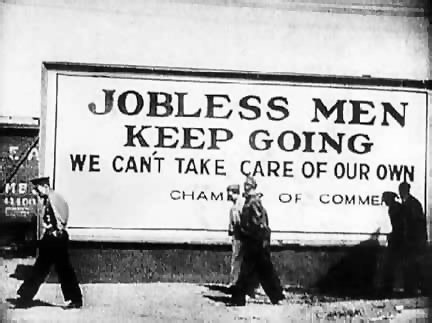
For those playing at home, that's approaching twice the number of folks down on their heels during the Great Depression, and a number that continues to grow monthly.
The insidious angle to this is, as the final door closes behind these people, it closes with finality. Rental agreements require good credit ratings, security deposits and first-and-last month's rent, standards and ready cash that the long-term bum isn't going to be able to meet, even if they can secure some kind of wage after falling off the grid. Once they're out on the street, they're going to be staying there for a while.
Friday, August 6, 2010
The Phone Interview
Today I had another in a continuing series of phone interviews. For the uninitiated, the phone interview is a means of quick disqualification for a culled group of qualified applicants. In essence, if you receive a phone interview, a face-to-face interview is not yours to win - it's yours to lose.
 The tricky bit is that a phone interview is like a like hitting a piñata; there is no possible way of telling whether you're saying the right thing or wrong thing until you receive a concrete notice of an on-site interview... or not. I have not yet had a phone interview that ended with anything less than a veiled hint that the rest of the applicants were just a formality. And yet, here I sit.
In this particular case, I was told that there were ten other applicants to screen; three, perhaps four, will be granted a face-to-face interview, after which a candidate will most likely be chosen to fill the position.
There are a number of sites online that offer suggestions for succeeding in a phone interview, but none clearly elucidate the most important aspect - that this is not an interview designed to bring you in - it is an interview to exclude you. For example, in this interview the tone of the interview was extremely upbeat and positive... until the following question came up:
"Now, as to salary... we're not sure where... we haven't set a salary for this position yet. What would you consider fair?'
Here, to me, was an exclusionary point. With ten years experience and a mid-five figure salary in the past, I may have priced myself out of consideration. In the past, dancing around the subject with the word "negotiable" would have been appropriate. In this economy, however...
I chose to inform the interviewer of my circumstance, and placed my minimum salary requirements precisely at my unemployment payment level - roughly half my former salary - with a slight increase to cover expected yearly travel expenses. "Beyond that," I continued, "anything more would be largesse."
There are those who would argue that honesty may not be the best policy. Most of those people have not experienced unemployment in this economy. The fact is, I would work for that wage at this point, and stating so honestly, explaining the circumstance - while making it clear that a more reasonable sum would be appreciated - places me absolutely in the position-to-beat. Other applicants would have to surpass my level of experience and not price themselves out of contention before taking my place on the hiring line.
At least, that's what I believe. Welcome to the land of piñata. I'll keep you informed.

In this particular case, I was told that there were ten other applicants to screen; three, perhaps four, will be granted a face-to-face interview, after which a candidate will most likely be chosen to fill the position.
There are a number of sites online that offer suggestions for succeeding in a phone interview, but none clearly elucidate the most important aspect - that this is not an interview designed to bring you in - it is an interview to exclude you. For example, in this interview the tone of the interview was extremely upbeat and positive... until the following question came up:
"Now, as to salary... we're not sure where... we haven't set a salary for this position yet. What would you consider fair?'
Here, to me, was an exclusionary point. With ten years experience and a mid-five figure salary in the past, I may have priced myself out of consideration. In the past, dancing around the subject with the word "negotiable" would have been appropriate. In this economy, however...
I chose to inform the interviewer of my circumstance, and placed my minimum salary requirements precisely at my unemployment payment level - roughly half my former salary - with a slight increase to cover expected yearly travel expenses. "Beyond that," I continued, "anything more would be largesse."
There are those who would argue that honesty may not be the best policy. Most of those people have not experienced unemployment in this economy. The fact is, I would work for that wage at this point, and stating so honestly, explaining the circumstance - while making it clear that a more reasonable sum would be appreciated - places me absolutely in the position-to-beat. Other applicants would have to surpass my level of experience and not price themselves out of contention before taking my place on the hiring line.
At least, that's what I believe. Welcome to the land of piñata. I'll keep you informed.
Sign Me Up!
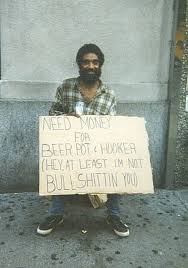
In preparation for living off the land, I've been researching bum signs. One of the more creative aspects of street living, it's a combination of street art and practical marketing that can pay off in a solid meal without the need for a paycheck.
Besides the need for a steady stream of foot traffic (more on that later), the success or failure of your panhandling endeavor largely depends on the strength of your advertising. Unlike the traditional job search, mooching is an entirely egalitarian endeavor, paid for by fans of your personal style and message. Here are some quick tips to succeed as a human billboard.
1) Size matters - No one wants to see a bum; your disturbing appearance in the tidy order of the working world is unnerving. People will avoid your gaze, and instead acquaint themselves with the details of the pavement beneath their feet, or suddenly feel the need to check their watches. To suceed, you need to engage at a distance, create a positive initial impression and somehow cull goodwill from an apathetic audience in a matter of seconds. That's going to require a sign that can be read from at least 12' away. You're going to need a minimum of 3'X 2' for a canvas, with the optimum size being 4'X 3'.

2) SOB stories don't sell - Your condition is inherent in your mission; I repeat, your disturbing appearance among the employed on the street is unnerving. Underscoring this point on your sign will harm your campaign, unless you are trying for the hardcore pity payment, in which case you'll need to work on your appearance to seem especially helpless and downtrodden.
Most of our new wave hobos will come from a position of economic downturn; it's a situation that pedestrians can relate to, and therefore it is best to engage your audience from the position of a helpless equal. In the thirties, the phrase was, "Brother, can you spare a dime?" Everything that is old is new again - this is your ideal panhandling positioning.

4) Self-effacing is best - Political rants are not only useless, but will dissuade otherwise willing contributors by assaulting their belief system.Similarly, anger or bitterness makes you a less appealing figure. A gentle message with self-effacing humor is your best bet to catch the attention and sympathy of the working masses.
Thursday, August 5, 2010
Which to use: shopping carts and the homeless off-roader
Everyone likes to be prepared for major life changes. In expectation of my imminent homelessness, I decided to do some research into the best available bum winnebago, for cartage and storage while living life on the hoof.
Expect a full report in my upcoming "Bobneedsjob.com," but for those of you in need of a quick overview, here we go.
1) Avoid Convenience Carts. Sure, they look sporty, and your needs may seem modest. At first glance, they seem to be perfect companions for an out-on-the-street lifestyle. But the several factors limit the convenience cart in both form and function.
 Note the small wheelbase: almost all of the model 5 cart setbacks can be linked back to the out-of-store instability caused by the 23"X10" trapezoidal wheelbase.
At 32 pounds, the convenience cart allows for a mere 2,500 cubic inch storage area in the main basket, with another reported 2,700 cubic inches available in the lower tray. Keeping in mind that the lower tray is all but useless during long-range, varied terrain travel, the weight-to-carriage ratio is impossibly high.
In addition - once again due to the small wheelbase - the convenience cart is extremely unstable in topheavy situations. It doesn't take much overfilling to create an inbalance that will lead to roll-overs in tight turns, on unstable terrain, and even caused by pavement cracks and minor potholes.
Keep in mind that, although the convenience cart and full shopping cart share the same handle height at 39 inches, the full shopping cart holds its base load only sixeen inches off the road, while the convenience cart carries its high-boy basket almost three feet in the air. This makes for an atrocious center of gravity for all but the most forgiving of circumstances.
Forgo the convenience cart; you'll thank me for it later.
2) Plastic or Steel?
Now that we've settled on the full-sized cart as your primary means of storage and transport, the question comes to whether you should liberate a plastic cart or the old, classic steel Bessie.
 In both cases, road stability is vastly improved by its 24" X 39" footprint; both on-road and off, spillage is almost impossible to achieve accidentally, making the classic cart a solid performer.
With a spacious 18,000 cubic inch capacity and a stable, low center of gravity, it's practically a no-brainer. Add to that the convenience of the quick-access seating area for frequently used items, and you're all set for a life on the road.
The question comes down to whether you should seek either the steel or plastic basket as your home-away-from-homelessness. The answer is esoteric, and dependent on your hobo lifestyle.
The steel cart weighs in at a hefty 63 pounds while its plastic cousin weighs in at 48; this gives the plastic cart an initial advantage in cargo headroom, but the answer may not be all in the weight.
A shopping cart serves many purposes in off-the-grid living. Not just a means of property transport, sometimes it must double as emergency shelter - at which point the steel cart shows it's massive advantage.
For rigidity and strength, plastic carts use X-Ribs to beef the structure. This may be fine for transport, but agonizing as even a temporary living structure. The ribs cut into every area of pressure contact, making for an agonizing oasis against the elements. A light, folded blanket, on the other hand, will pad the steel cage mesh brilliantly, making your time inside vastly more bearable.
Those with a tent, a fridge box or lean-to in the bushes may consider a plastic cart to for the benefits of a lighter carriage weight, while heavy duty rangers should consider the daily versatility of a metal rig.
Expect a full report in my upcoming "Bobneedsjob.com," but for those of you in need of a quick overview, here we go.
1) Avoid Convenience Carts. Sure, they look sporty, and your needs may seem modest. At first glance, they seem to be perfect companions for an out-on-the-street lifestyle. But the several factors limit the convenience cart in both form and function.

At 32 pounds, the convenience cart allows for a mere 2,500 cubic inch storage area in the main basket, with another reported 2,700 cubic inches available in the lower tray. Keeping in mind that the lower tray is all but useless during long-range, varied terrain travel, the weight-to-carriage ratio is impossibly high.
In addition - once again due to the small wheelbase - the convenience cart is extremely unstable in topheavy situations. It doesn't take much overfilling to create an inbalance that will lead to roll-overs in tight turns, on unstable terrain, and even caused by pavement cracks and minor potholes.
Keep in mind that, although the convenience cart and full shopping cart share the same handle height at 39 inches, the full shopping cart holds its base load only sixeen inches off the road, while the convenience cart carries its high-boy basket almost three feet in the air. This makes for an atrocious center of gravity for all but the most forgiving of circumstances.
Forgo the convenience cart; you'll thank me for it later.
2) Plastic or Steel?
Now that we've settled on the full-sized cart as your primary means of storage and transport, the question comes to whether you should liberate a plastic cart or the old, classic steel Bessie.

With a spacious 18,000 cubic inch capacity and a stable, low center of gravity, it's practically a no-brainer. Add to that the convenience of the quick-access seating area for frequently used items, and you're all set for a life on the road.
The question comes down to whether you should seek either the steel or plastic basket as your home-away-from-homelessness. The answer is esoteric, and dependent on your hobo lifestyle.
The steel cart weighs in at a hefty 63 pounds while its plastic cousin weighs in at 48; this gives the plastic cart an initial advantage in cargo headroom, but the answer may not be all in the weight.
A shopping cart serves many purposes in off-the-grid living. Not just a means of property transport, sometimes it must double as emergency shelter - at which point the steel cart shows it's massive advantage.
For rigidity and strength, plastic carts use X-Ribs to beef the structure. This may be fine for transport, but agonizing as even a temporary living structure. The ribs cut into every area of pressure contact, making for an agonizing oasis against the elements. A light, folded blanket, on the other hand, will pad the steel cage mesh brilliantly, making your time inside vastly more bearable.
Those with a tent, a fridge box or lean-to in the bushes may consider a plastic cart to for the benefits of a lighter carriage weight, while heavy duty rangers should consider the daily versatility of a metal rig.
Wednesday, August 4, 2010
Full on Media Blitz!
Welcome to "Bob Needs Job - The Blog." I'm Bob. I need a job. Hiya.
 It was suggested that blogging might be the key to gainful employment... or, at the very least, a means to make me the first homeless superstar.
I can hardly wait.
I figure that if I'm going to do this, I may as well go down in spectacular flames. I shall build a media empire on my destruction. To that end, I have branded myself. ©
Welcome to the Bob Needs Job media empire: Join me as I fall through the cracks of society and gradually lose my dignity, possessions, sanity and end up tottering down the street with a straggly beard, pushing a shopping cart and talking to myself. I've made it easy to track my descent - behold my holdings:
1) Bobneedsjob.com - Coming soon, my Joomla masterpiece of descent into poverty. We'll be reviewing shopping carts for best mileage, cat food critique, breaking news on the freshest garbage to forage, and so much more. Join me, won't you?
Joomla is no problem; I'm pretty competent with the back end stuff. At one time, I would have called that one of my saleable skills. If you know anyone who's buying, please do let me know.
2) Bob Needs Job - The Blog - Why, here you are already! You really are one of the early adapters of the electronic frontier. Just think - you'll be able to say, "I remember him when he still had a roof over his head." Here, you and I will chat and muse on the many aspects of a life with no prospects.
I maintained a weekly column for several years; the difference between this blog and that column is that one I was paid for, and this one I'm doing for absolutely free. Of course, you get what you pay for.
3) Bob Needs Job - The Twitter - Because you just have to know what I'm doing at any moment in my exciting, jobless day. I'll keep you up-to-the-moment with my inaction! Follow me - I'm moving mighty slow.
4) Bob Needs Job - The Facebook - This is where I book my face.There will be exciting, exclusive online secrets I'll only tell my shabby BFFs in Facebook - nowhere else. There - don't you feel left out already? Well, there's good news tonight - I'm not very particular about my friends. Join my inner circle - friend me today! Or tomorrow, I don't care.
Need to contact me? No problem! You can contact Bob Needs Job through every possible email dumpster:
bobneedsjob@gmail.com
bobneedsjob@yahoo.com
bobneedsjob@aol.com
bobneedsjob@hotmail.com
bobneedsjob@mail.com
Send me your job opportunities, viagra advertisements, naughty pictures and secret messages!

I can hardly wait.
I figure that if I'm going to do this, I may as well go down in spectacular flames. I shall build a media empire on my destruction. To that end, I have branded myself. ©
Welcome to the Bob Needs Job media empire: Join me as I fall through the cracks of society and gradually lose my dignity, possessions, sanity and end up tottering down the street with a straggly beard, pushing a shopping cart and talking to myself. I've made it easy to track my descent - behold my holdings:
1) Bobneedsjob.com - Coming soon, my Joomla masterpiece of descent into poverty. We'll be reviewing shopping carts for best mileage, cat food critique, breaking news on the freshest garbage to forage, and so much more. Join me, won't you?
Joomla is no problem; I'm pretty competent with the back end stuff. At one time, I would have called that one of my saleable skills. If you know anyone who's buying, please do let me know.
2) Bob Needs Job - The Blog - Why, here you are already! You really are one of the early adapters of the electronic frontier. Just think - you'll be able to say, "I remember him when he still had a roof over his head." Here, you and I will chat and muse on the many aspects of a life with no prospects.
I maintained a weekly column for several years; the difference between this blog and that column is that one I was paid for, and this one I'm doing for absolutely free. Of course, you get what you pay for.
3) Bob Needs Job - The Twitter - Because you just have to know what I'm doing at any moment in my exciting, jobless day. I'll keep you up-to-the-moment with my inaction! Follow me - I'm moving mighty slow.
4) Bob Needs Job - The Facebook - This is where I book my face.There will be exciting, exclusive online secrets I'll only tell my shabby BFFs in Facebook - nowhere else. There - don't you feel left out already? Well, there's good news tonight - I'm not very particular about my friends. Join my inner circle - friend me today! Or tomorrow, I don't care.
Need to contact me? No problem! You can contact Bob Needs Job through every possible email dumpster:
bobneedsjob@gmail.com
bobneedsjob@yahoo.com
bobneedsjob@aol.com
bobneedsjob@hotmail.com
bobneedsjob@mail.com
Send me your job opportunities, viagra advertisements, naughty pictures and secret messages!
Subscribe to:
Posts (Atom)