Life goes on, and this weekend I'll be continuing an eight-year tradition moderating Q&A sessions at Monster-Mania at the Crown Plaza Hotel in Cherry Hill. It's old home week - I'll be talking to two old friends; Dick Warlock (Michael Myers in Halloween II, and Kurt Russel's personal stuntman for 25 years) and Herschell Gordon Lewis (The creator of the Gore Film and Marketing Guru extraordinaire, the first man to use product placement in movies, and the pioneer of direct mail marketing). In addition, I'll be chatting with Julian Sands (Boxing Helena, The Killing Fields, 24) and, depending on scheduling, I'll be hosting a reunion for stars from Friday the 13th.
Over the course of years, I've made hundreds of contacts in the film industry. Unfortunately, they don't mean much here on the East Coast, where a little influence would come in extremely handy right now. However, four shifts in front of an audience of 300-500 people does present a bully pulpit to bring "my" people here to BobneedsJob.com.
Herschell will be so proud...
This show will be bittersweet; the next show in Maryland is set for September, and will be the first I will miss; by then, I will either be newly working, or on the street.
Neither option will allow for time off.
Friday, August 20, 2010
Thursday, August 19, 2010
The Debut of the BobneedsJobmobile!
The three primary rules of real estate and outdoor advertising are said to be "Location, Location, Location," and this afternoon I'll be joining FTD, Terminex and your local pizza delivery guy in trumpeting my cause to the world. Soon, I'll be a mobile fixture of the open highway. I'll snap some pictures for inclusion later; until then, behold this startling re-creation.
Ordinarily, writers aren't the most extroverted of critters, and the idea of tooling down the highway in a decked-out clowncar should be incredibly embarrassing. Strangely, I'm feeling a little exuberant. Nothing else has worked in this economy, and there's something cheerful about making the workaday world a little more surreal.
Just to be on the safe side, I also ordered a smaller set, for use on "My Other Car Is A Shopping Cart." With only two payments left until I hit the magic "99 Weeks," I have to be prepared for any eventuality.
Wednesday, August 18, 2010
Ground broken on Bobneedsjob.com
If you've happened here by way of my advertising, welcome to my temporary home away from homepage on Blogger. But never fear - ground has been officially broken on Bobneedsjob.com, the Joomla!- driven website component in my media blitz for employment.
To differentiate between these two sites, here you can track my daily foiled attempts at employment and subsequent personal appearances with a shopping cart on a street near you. On the proper site, we'll be tracking the day-to-day employment picture for the area by way of the local newspaper advertisements, and interviewing the local police, politicos and governmental agencies involved in keeping people like me off your streets, and possibly alive.
I know. I am, by definition, a person with too much time on my hands. But give me credit - I'm trying like crazy to reduce it, preferably by 40 hours a week or more.
You can't get there from here
My most recent rooting through the job listings turned out not one but two possible positions at Comcast - perfect matches for my qualifications and experience. One was an open position for a content creator, the other for an online editor; both jobs I maintained, simultaneously, for ten years.
As you can imagine, I was thrilled to forage through their four-page application, and I hit the SUBMIT button with supreme confidence. Within minutes, I received an email confirmation.
"Thank you for applying for the position of Staff Accountant (2)..."
No. That's not right...
An exhaustive search of the site offered no options for contacting the company's Human Resources department - or any department at all, for that matter. Vexed, I simply assumed that there was some tremor in the Interwebs, and applied again - with precisely the same result.
Obviously, the human touch was needed.
I moseyed down to my local Comcast office, and sought out a pulse. Not surprisingly, the locals don't handle Human Resource tasks - surprisingly, however, they don't handle technology or communications issues, either. "That's the Internet - you'd have to get in touch with them."
How? They knew not; like Zardoz, the Internet - and Comcast's presence on it - was some mystical sentient machine that hovered someplace fifty feet in the air above a wind blasted prairie.
Feeling especially flexible, I decided to beard the monster in his lair. I chatted with the Internet.
The Internet, after understanding that my service was not endangered, I had rebooted my application and the problem lie in a database glitch, assured me that the problem was not the Internet: it was a Human Resources mistake. Contacting Human Resources, however, was beyond its ken. It suggested the local office, the website FAQ, and finally settled on the idea that my best course of action was to apply a third time through the Internet. Is there anything else it could help me with? I thanked it, and told it I didn't think so.
I took two courses in accountancy during my Marketing degree - perhaps the exercise was not completely in vain. But y'know... what Comcast really needs is a good, experienced online editor.
Tuesday, August 17, 2010
Solicitations from Senator Lautenberg
It's been a month since I played pen-pal with Senator Frank Lautenberg, and guess who just called me?
No - Zach did.
Zach works out of the Senator's Trenton office, and he sent many happy returns from Frank; specifically, he happily returned me to Senator Diane Allen, and the Burlington County Board of Chosen Freeholders. It was explained to me that the Senator doesn't really actually involve himself with the state of the state so much. Not as such.
He's more of a hands-off kind of guy.
I was informed, however, that if at any time I needed to call his office for help, don't hesitate. I asked Zach what specific kind of help I can call the Senator for.
He hesitated. That was a bit of a stumper.
It ends up, I can call Zach to find out who else I can call that isn't Frank Lautenberg, preferably Diane Allen. This is a great comfort to me; of all the folks I did contact, Diane Allen is the only one who didn't bother to check my pulse. Now I can call his Zach to get her Zach.
Clearly, progress is being made.
And now, a word from our sponsor...
"A Writer writes. Always." I don't often take job advice from Billy Crystal, especially after The Adventures of Rocky and Bullwinkle, but lately I've been a lot less particular about career guidance. And, as advice goes, it matches the best I've gotten from professional councilors. No one really knows what works in today's economy - be passive, be aggressive, be passive-aggressive... bring whatever talents you may have to bear.
And a writer writes.
Although my past life involved much more than pushing words around, it is becoming more and more undeniable that communication with a larger audience is vital to connecting with some form of employment. And that, gentle reader, is why I have lured you here.
Hi there.
I'll try to keep you entertained here - no one wants to lose an audience - and I ask you to notice I have not tried to monetize this site in any way. But the purpose of the site is self explanatory, and I'm asking for your assistance.
A quick look at my resume will give you an idea of the scope of my abilities; if you'd rather not, however, I'd be glad to give you a quick run-down right here. Ten years of Internet publishing experience, including journalism, column work, blogging, navigation design, vertical site construction, content management systems, search engine optimization, public speaking, online editing, file transfer protocol, HTML, Adobe Create Suite, Microsoft Office, Joomla!, video editing... and so much more.
I should also point out that I am fully capable of anything beneath those lofty qualifications. To those who might think I may be "overqualified" for a lesser position, I would like to suggest that I am even more overqualified for park bench naps and dumpster diving. My optimal employment in this economy involves an income sufficient to keep a roof over my head - and, preferably, Showtime.
Dexter is coming up, after all.
From Philadelphia to Vineland, from Glassboro to New Brunswick - I'm out here, I'm available, and I'm beyond eager to find a steady source of cutter to keep me solvent. Subscribe me, tweet me, see me, feel me, touch me, heal me. Tell your friends, relatives, Human Resource people and neighbors about the madman with the blog. Become part of my network - me and my career councilor will thank you.
Feel free (extremely so) to write me at bobneedsjob@gmail.com - Or yahoo.com, for that matter. Words of good cheer, job leads, and offers of matrimony from monied matrons are all warmly encouraged. I thank you.
Now, back to your regular chatter.
Monday, August 16, 2010
Saturday, August 14, 2010
Going Mobile
There comes a point when the job search becomes Kafkaesque; with only thirty days remaining until I join the ranks of the homeless, my friends at New Jersey's "One Stop" Employment Center are begging me to spend no more than two hours online, searching for employment. Instead, I'm told, I should go to McDonald's and pester random customers who may know someone who may have a friend - who has a friend - that might know of a job.
That is a true statement.
This is the professional opinion of a job search expert.
This is what the economy has come to.
As to McDonald's, I've had people flip me off there for making them wait as the server nuked my Fillet O' Fish; not only doesn't this seem like sound marketing, I'm pretty sure it's solicitation, and illegal. Far be it from me, however... I promised to go to and get some business cards printed.
And so I did.
It was at check-out, however, that this absurd exercise took on new life. Why pester pedestrians one at a time, when I can accost hundreds of commuters on the highway? If, in fact, the economy has turned a job search to mass marketing, a broadsheet serves better than a business card. And so, my car is now a traveling billboard.
To my new, mobile readers, welcome to the New American Economy. Welcome to my world. To the left, you'll find my resume - if you have a friend who has a friend that can use the talents of a 10-year veteran of Internet publishing, I'd appreciate it if you'd send them my way. And, if you don't, I invite you to stay for the ride. Life is about to get interesting, and I invite you to follow the adventures of the most literate bum you know.
That would be me.
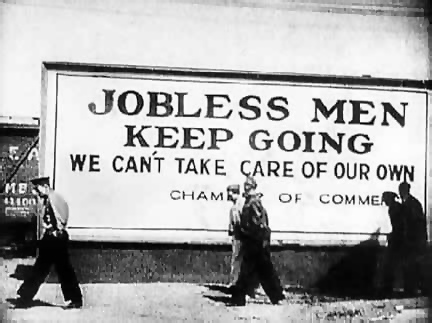
Unemployment - outside of politics
I have avoided - and will continue to avoid - the political aspects of long-term unemployment in here; I consider the situation... darkly humorous.
There are those who believe that a Tier V addition to unemployment is unnecessary, but have nothing to offer citizens that exhaust their benefits. Perhaps they assume that people will pop, like balloons, after 99 weeks and disappear from the face of the planet. Unfortunately, this isn't the case - they'll hang around.
They'll hang around the streets, around the parks, around the temperature-controlled shopping malls. They'll hang around the convenience stores in the suburbs, begging for change - a guy has to eat.
Despite the charm of living under the open sky and the healthy breeze of bracing autumn mornings, your average ex-employee may find life on the road a jarring, demoralizing turn. Under the circumstances, I would think that alcohol may become a welcome daily distraction. People may decide that, with their social contract officially broken with society, a little bit of petty thievery and misdemeanor behavior would not be inappropriate to survive.
The only socially acceptable alternative to unemployment is employment - and employment that allows you to keep fed with a roof over your head is scarce to extinct. The only alternative is the open road; Burlington County NJ has no plans - nor any plans in the offing - for the feeding and housing of a burgeoning population of tramps.
Ignore the problem, and it will go away. Except it won't.
To be frank - and arrogant - I will not go gently into that good night. I have the aspect and education to give any existing part-time job a run for its money, and if they exist, I'll be taking two of them. And, under the circumstances, if that leads to one of my other hobo brethren littering the genteel streets of my hometown, so be it. Moorestown cops will transport their bums to the outskirts of Delran, Delran cops will transport theirs to Cinnaminson, and Cinnaminson will transport them back to Moorestown. The hobo-go-round will rotate the faces, but not change the numbers.
As I've stated earlier, when the genie is loosed from the bottle, it won't go away easily; a solid work history, a good credit score and glowing references are all necessary to find an apartment. The unhomed are unqualified for rehousing, even if they find employment. So, lacking a public housing alternative, when they hit the street, they're there for the long term.
Is this a "Dire Prediction," a "Crackpot Rant," or simple economics? Google news - "Tent Cities." Coming to your hometown soon.
Friday, August 13, 2010
Must be available to work other hours as necessary
One of the logical arguments put forward on the unemployment front is, "Well, why not get yourself a part time job? At least it's something." In actuality, it's not - not when you "Must be available to work other hours as necessary."
Taking two part-time jobs would solve my problems - but, in the New American Economy, I'm only allowed to have one.
Employment being at a premium these days, the folks with the checkbooks are spending the money with ruthless wisdom; avoiding the expense of full-time employees, they still need to be able to cover all operating hours with a minimum workforce, including possible absences or employee turnover. Thus, a part-time position now includes being on-call, unpaid, outside of assigned shifts.
Needless to say, the possibility of stacking jobs when one - or both - require random access to your weekday is approximately nil. As sure as the sun rises, one job or the other will demand hours you've already committed elsewhere.
As a result, to qualify for a majority of available part-time jobs - including Comcast, Wawa, McDonalds - you must agree to live on $200.00 weekly gross, which over the course of a month will allow you to either live indoors or eat, maintain a vehicle, pay for electricity and continue to receive outside communications. Neither choice, alone, is viable for survival.
It's something, all right... just not enough.
Thursday, August 12, 2010
"People will have to become entreprenuers..."
That quote came from one of the good folks over at New Jersey's "One Stop" employment center, in regard to what is seen as "The New American Economy." The gist of the conversation was, if you can't offer an employer something quantifiably profitable, you'd better find something quantifiably profitable for yourself.
The definition of "Quantifiably Profitable" may be nebulous in terms of employment, but it's crystal clear in regard to the unemployable. Get a spray bottle and a squeegee, boys - you're on your own.
There are some brave souls that are born for entrepreneurship, and some of them actually succeed. Not a majority, but some.
Ordinarily, those successful business owners start part-time, in order to hold a job while the new venture takes root. That also helps to provide seed money for the infant business, since the helpless little concern will die without a continuous stream of capital as it grows to independence.
Under this New American Economy, however, the unemployed need to find a start-up with a low initial cash outlay, and a veneer-thin overhead. Three options come immediately to mind.
1) The Lemonade Stand: seasonal, but sure, the lemonade stand can be maintained with a cooler, a few bags of ice, a couple jugs of Crystal Light and a sleeve of dixie cups.
You'll need a marker and a piece of cardboard for advertising.
Your ideal market segment is the on-the-go consumer who seeks refreshment and does not trust vending machines. You're the human touch - the friendly vendor of high-quality summer beverage. Customer Service is key here - this is a job tailor made for a "people person."
Remember that you must keep your product cost below $1.25 - the cost of 12-ounce cans in a vending machine. Price your product with serving size in mind.
2) Red Light Window Washing: A squeegee, a spray bottle and a corner is all you need; but with the low overhead comes long hours. Red Light Window Washers work on tips - there is no guarantee of payment from one windshield to the next.
Once again, customer service and a positive mental attitude is key. In the old days, a well-dressed automotive attendant offered this service at filling stations with a smile. You're taking over that job: a nice, white shirt, a tie and a can-do attitude can get you far. Try to find a high-traffic corner, and be prepared to change locations often when the local constabulary shooes you away.
Be prepared for high competition in this industry, as the economy continues to spawn forced entrepreneurs. Those with management experience may want to consider franchising.
3) Apples: It's the traditional, time-tested depression favorite. That and pencils, but nobody writes longhand anymore.
On the bright side, the current trend towards healthy eating is ripe for a resurgence in apple vending. One a day keeps the doctor away - perfect for those without health insurance. It's a win-win situation for both you and your customers.
I'm going to give you one additional tip that I was saving for myself - dressing in depression-period clothing gives you undeniable visual appeal, and sends a clear message about your intent. It's a winner.
Tuesday, August 10, 2010
Times that try men's souls: on to Valley Forge!
When your specialty is hooking up nouns and phrases and clauses, jobs are scarce outside of Conjunction Junction. That's what you get for not doing a real job. So, today's foray into the world of boundless optimism takes me to a Randstat opportunity at the site of George Washington's darkest hour.
Opportunities like these, directly seeking a person who does exactly what you had been doing for a decade, tend to be the most exciting - and frustrating - job listings one runs into. Logic and pride dictate that, naturally, you are the only person who could possibly fill this position. Experience and reality, on the other hand, tend to prove that not only aren't you the only one, but there is still a very good chance you won't be given so much as the courtesy of a nice "Get Lost" letter.
There is a certain amount of irony in the fact that, with time ticking away to personal disaster, my current last, best hope of redemption may lie in at the scene of Washington's greatest hardship.
Reviewing his options while wintering at Valley Forge, Washington wrote, "If all else fails, I will retreat up the valley of Virginia, plant my flag on the Blue Ridge, rally around the Scotch-Irish of that region and make my last stand for liberty amongst a people who will never submit to British tyranny whilst there is a man left to draw a trigger."
At least George had a back up plan. I don't think the Blue Ridge Scotch-Irish are my demographic...
Monday, August 9, 2010
In search of a suitable hat
Life without a roof means a life in the sun, and with it, the melanoma that flesh is heir to. This, I suppose, is why most hobos, tramps and bums are ordinarily pictured in haberdashery. Although not ordinarily a clothes horse, I would hate to break a long standing tradition. So, I am in search of a suitable chapeau.
Chaplin - and most of the Keystone tramp comics - favored the bowler as the symbol of crumbled prosperity, while the Depression era hobos tended towards the ubiquitous fedora. In modern times, the hoodie and baseball cap combination has been the downtrodden's choice.
I've never been one to follow the crowd, and as I have already laid claim to the bum moniker "The Professor" for this Depression (imitators, take note - ®), I think I need to choose more in keeping with my position in the hobo community as the smartest bum on the block.
I've become partial to the Henschel Breezer, in earth tones to hide the dirt. Old-school collegiate hatband, with a wide 2.5-inch brim to keep the radiation at bay, the hat holds its style well while still looking capable and suitably "outdoorsy."
Admittedly, my first choice would have been a classic fedora, but I'm afraid that with my khakis and messenger bag, people would mistake me for a bloated Indiana Jones.
A group of hungry people, talking about steak
Human Services buildings score high on the misery scale, right behind trauma centers and police stations; if you're there, and not paid to remain there, you've got some pretty dire problems cooking. Everyone is familiar with Emma Lazarus' lines from The New Colossus etched on the Statue of Liberty: "Give me your tired, your poor/Your huddled masses yearning to breathe free." These buildings are where society cashes that invitation's checks.
Today, as part of the huddled masses, I invaded the basement of one of these buildings to re-acquaint myself with an old nemesis; The Professional Services Group. It is an odd duck program; unlike most of the activities in buildings like this one, it is aimed at the white collar workers.
The people that, in theory, were never supposed to end up here.
My first experience with the concept was not promising - in fact, it bordered on the delusional. Set adrift from the workaday world, it was the business world recreated in microcosm, in a small cloistered room at the end of some anonymous hallway. There, people marched in at nine in the morning sharp in full business attire, and wrote newsletters to each other. The topics were surreal, considering the sources - "How to find and keep your dream job," by Eddie Kloyski... an 8-month unemployed middle manager.
Once enough of these pearls were strung together, they were printed out, collated and stapled, and everybody who contributed got a copy. Then a pile was left on a table somewhere, in case some passing drifter needed free enlightenment.
In between issues, they would interview each other, offering the kind of sage Human Resources advice that can only come from someone who has never actually worked in Human Resources before.
It was make-work; it was a support group, disguised as positive action. It was an illusion of normality in an extremely abnormal situation for people used to having some control and function in their lives. In the end, it was a non-reality I could not subscribe to.
And so, here I am in a different building, the same program, and a laced, tacit promise of a different mindset. Laced with warnings of "clunkers" and "troublemakers" that didn't fit the program. And, among the handouts... a newsletter.
I wonder - does my skepticism rank me as a "Clunker" and "Troublemaker?" It wouldn't be the first time.
Sunday, August 8, 2010
What do you do with 5 million bums?
The current estimate of folks who have run through their unemployment and remain without jobs and income is floating around the 5 million mark here in the good ol' USA, leaving me to wonder what exactly you do with that many rampaging hobos on the loose. To put that number in perspective, we could fill the Lincoln Financial field 73 times. Including the cheap seats.
Another way of looking at it is, there are twice as many tramps as there are people behind bars in America, and that number is growing monthly at an alarming pace. How alarming? In July, the government reported the total number of unemployed at 14.6 million - which is about the same number of people out of work during the Great Depression. This number does not include 8.5 million working part-time because full-time work is not available, nor the 2.6 million "marginally attached to the labor force," who have simply given up looking for work. That brings the government number up to 24.7 million potential panhandlers and Hooverville residents in total.
For those playing at home, that's approaching twice the number of folks down on their heels during the Great Depression, and a number that continues to grow monthly.
The insidious angle to this is, as the final door closes behind these people, it closes with finality. Rental agreements require good credit ratings, security deposits and first-and-last month's rent, standards and ready cash that the long-term bum isn't going to be able to meet, even if they can secure some kind of wage after falling off the grid. Once they're out on the street, they're going to be staying there for a while.
Friday, August 6, 2010
The Phone Interview
Today I had another in a continuing series of phone interviews. For the uninitiated, the phone interview is a means of quick disqualification for a culled group of qualified applicants. In essence, if you receive a phone interview, a face-to-face interview is not yours to win - it's yours to lose.
The tricky bit is that a phone interview is like a like hitting a piñata; there is no possible way of telling whether you're saying the right thing or wrong thing until you receive a concrete notice of an on-site interview... or not. I have not yet had a phone interview that ended with anything less than a veiled hint that the rest of the applicants were just a formality. And yet, here I sit.
In this particular case, I was told that there were ten other applicants to screen; three, perhaps four, will be granted a face-to-face interview, after which a candidate will most likely be chosen to fill the position.
There are a number of sites online that offer suggestions for succeeding in a phone interview, but none clearly elucidate the most important aspect - that this is not an interview designed to bring you in - it is an interview to exclude you. For example, in this interview the tone of the interview was extremely upbeat and positive... until the following question came up:
"Now, as to salary... we're not sure where... we haven't set a salary for this position yet. What would you consider fair?'
Here, to me, was an exclusionary point. With ten years experience and a mid-five figure salary in the past, I may have priced myself out of consideration. In the past, dancing around the subject with the word "negotiable" would have been appropriate. In this economy, however...
I chose to inform the interviewer of my circumstance, and placed my minimum salary requirements precisely at my unemployment payment level - roughly half my former salary - with a slight increase to cover expected yearly travel expenses. "Beyond that," I continued, "anything more would be largesse."
There are those who would argue that honesty may not be the best policy. Most of those people have not experienced unemployment in this economy. The fact is, I would work for that wage at this point, and stating so honestly, explaining the circumstance - while making it clear that a more reasonable sum would be appreciated - places me absolutely in the position-to-beat. Other applicants would have to surpass my level of experience and not price themselves out of contention before taking my place on the hiring line.
At least, that's what I believe. Welcome to the land of piñata. I'll keep you informed.
Sign Me Up!
Life on the open road does not preclude the need to eat; dumpster diving is a short-term solution, but you'll find out quickly that food that is not mottled, dank and discarded is one of the great pleasures in life. For that, you're going to need cash. And you're going to have to collect it, a quarter at a time.
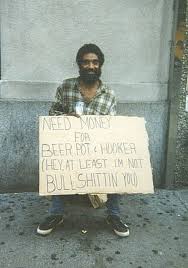
In preparation for living off the land, I've been researching bum signs. One of the more creative aspects of street living, it's a combination of street art and practical marketing that can pay off in a solid meal without the need for a paycheck.
Besides the need for a steady stream of foot traffic (more on that later), the success or failure of your panhandling endeavor largely depends on the strength of your advertising. Unlike the traditional job search, mooching is an entirely egalitarian endeavor, paid for by fans of your personal style and message. Here are some quick tips to succeed as a human billboard.
1) Size matters - No one wants to see a bum; your disturbing appearance in the tidy order of the working world is unnerving. People will avoid your gaze, and instead acquaint themselves with the details of the pavement beneath their feet, or suddenly feel the need to check their watches. To suceed, you need to engage at a distance, create a positive initial impression and somehow cull goodwill from an apathetic audience in a matter of seconds. That's going to require a sign that can be read from at least 12' away. You're going to need a minimum of 3'X 2' for a canvas, with the optimum size being 4'X 3'.
Your message must be concise, in a large font for ease of reading from a distance. Keep in mind that, at an average walking pace, pedestrians cover 1.5 feet per second. That's 90 feet per minute. Your message must engage and produce an intent to contribute in a fraction of that.
2) SOB stories don't sell - Your condition is inherent in your mission; I repeat, your disturbing appearance among the employed on the street is unnerving. Underscoring this point on your sign will harm your campaign, unless you are trying for the hardcore pity payment, in which case you'll need to work on your appearance to seem especially helpless and downtrodden.
Most of our new wave hobos will come from a position of economic downturn; it's a situation that pedestrians can relate to, and therefore it is best to engage your audience from the position of a helpless equal. In the thirties, the phrase was, "Brother, can you spare a dime?" Everything that is old is new again - this is your ideal panhandling positioning.
3) Adopt a position of penance - It could be argued that panhandling is your job; you must do it correctly to see profit from it. Avoid headphones, or other means of entertainment. Any sign that you are coping with your situation easily will dissuade possible contributors. Remember - panhandling is the ultimate in public relations; avoid any signal that might cloud your message. You are unemployed - you want to be employed - you are a destitute but honest citizen of a crumbling economy. Brother, can you spare a dime?
4) Self-effacing is best - Political rants are not only useless, but will dissuade otherwise willing contributors by assaulting their belief system.Similarly, anger or bitterness makes you a less appealing figure. A gentle message with self-effacing humor is your best bet to catch the attention and sympathy of the working masses.
Thursday, August 5, 2010
Which to use: shopping carts and the homeless off-roader
Everyone likes to be prepared for major life changes. In expectation of my imminent homelessness, I decided to do some research into the best available bum winnebago, for cartage and storage while living life on the hoof.
Expect a full report in my upcoming "Bobneedsjob.com," but for those of you in need of a quick overview, here we go.
1) Avoid Convenience Carts. Sure, they look sporty, and your needs may seem modest. At first glance, they seem to be perfect companions for an out-on-the-street lifestyle. But the several factors limit the convenience cart in both form and function.
Note the small wheelbase: almost all of the model 5 cart setbacks can be linked back to the out-of-store instability caused by the 23"X10" trapezoidal wheelbase.
At 32 pounds, the convenience cart allows for a mere 2,500 cubic inch storage area in the main basket, with another reported 2,700 cubic inches available in the lower tray. Keeping in mind that the lower tray is all but useless during long-range, varied terrain travel, the weight-to-carriage ratio is impossibly high.
In addition - once again due to the small wheelbase - the convenience cart is extremely unstable in topheavy situations. It doesn't take much overfilling to create an inbalance that will lead to roll-overs in tight turns, on unstable terrain, and even caused by pavement cracks and minor potholes.
Keep in mind that, although the convenience cart and full shopping cart share the same handle height at 39 inches, the full shopping cart holds its base load only sixeen inches off the road, while the convenience cart carries its high-boy basket almost three feet in the air. This makes for an atrocious center of gravity for all but the most forgiving of circumstances.
Forgo the convenience cart; you'll thank me for it later.
2) Plastic or Steel?
Now that we've settled on the full-sized cart as your primary means of storage and transport, the question comes to whether you should liberate a plastic cart or the old, classic steel Bessie.
In both cases, road stability is vastly improved by its 24" X 39" footprint; both on-road and off, spillage is almost impossible to achieve accidentally, making the classic cart a solid performer.
With a spacious 18,000 cubic inch capacity and a stable, low center of gravity, it's practically a no-brainer. Add to that the convenience of the quick-access seating area for frequently used items, and you're all set for a life on the road.
The question comes down to whether you should seek either the steel or plastic basket as your home-away-from-homelessness. The answer is esoteric, and dependent on your hobo lifestyle.
The steel cart weighs in at a hefty 63 pounds while its plastic cousin weighs in at 48; this gives the plastic cart an initial advantage in cargo headroom, but the answer may not be all in the weight.
A shopping cart serves many purposes in off-the-grid living. Not just a means of property transport, sometimes it must double as emergency shelter - at which point the steel cart shows it's massive advantage.
For rigidity and strength, plastic carts use X-Ribs to beef the structure. This may be fine for transport, but agonizing as even a temporary living structure. The ribs cut into every area of pressure contact, making for an agonizing oasis against the elements. A light, folded blanket, on the other hand, will pad the steel cage mesh brilliantly, making your time inside vastly more bearable.
Those with a tent, a fridge box or lean-to in the bushes may consider a plastic cart to for the benefits of a lighter carriage weight, while heavy duty rangers should consider the daily versatility of a metal rig.
Subscribe to:
Posts (Atom)